


Fat has always been considered a negative part of our body, especially by women and in particular when it accumulates in certain “sensitive” areas.
Off-road drivers are generally athletes, and fat is a topic of little interest. The increase in sporting activity in middle and advanced age has led to a rise in the incidence of degenerative diseases affecting a large percentage of individuals.
These pathologies greatly influence the quality of life and lead to limitations in work activities and daily living.
Even young off-road drivers are subjected to traumatic events and repetitive, debilitating movements that can cause premature joint wear.
The regenerative capacities of cartilage following injury are extremely limited, therefore pathological processes at the joint level can easily lead to severe arthrosis.
While symptomatic therapies can be used in the early stages, more advanced stages require more demanding surgical treatments that carry greater risks.
Recent studies have shown that with the use of new bio-orthopaedic techniques it is possible to regenerate some tissues and delay the physiological evolution of degenerative processes, obtaining an improvement in the clinical picture.
In the field of regenerative medicine, the efficacy of treatment with mesenchymal stem cells (MSCs) in the treatment of osteoarthritis is highlighted due to their healing potential.
The first methods involved the use of cell cultures, with proliferation and consequent differentiation of MSCs that had to be surgically implanted. These methods, although valid, are complicated and very expensive and in fact one of the main disadvantages of these therapies is precisely the cost.
Today, there is more focus on using MSCs obtained from the patient himself and then immediately applied to help the healing of an injured tissue. Recent studies have shown that injecting a concentrate of MSCs obtained from bone marrow can lead to an improvement in symptoms and joint function.
However, taking a bone marrow sample is painful and demanding, requiring anesthesia and the use of a well-equipped operating room.
There is also the possibility of obtaining MSCs from body fat. This is of extreme interest because in addition to being very available (everyone has a little extra fat…), the collection can be performed on an outpatient basis and the fat contains stable MSCs that are not very sensitive to the patient’s age.
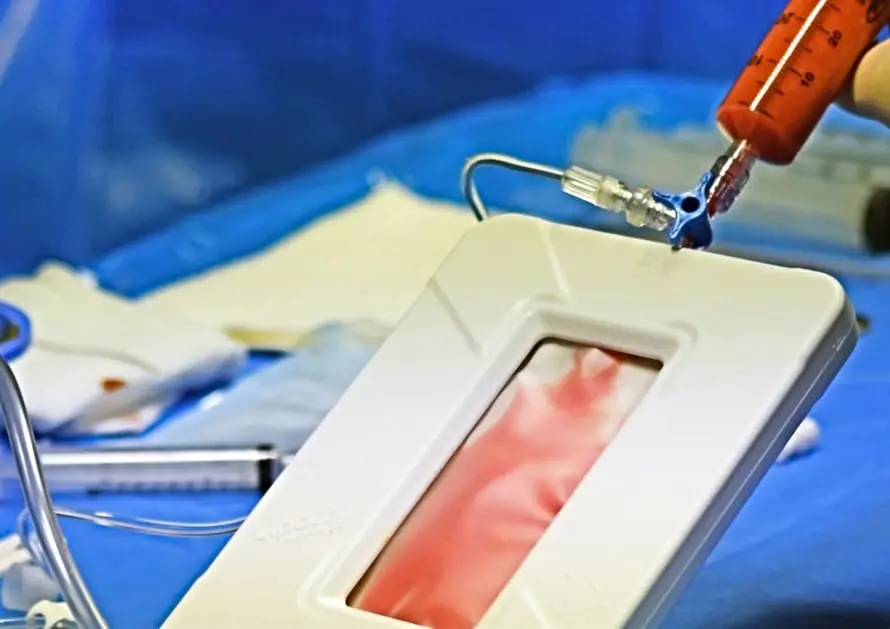
The Lipogems system, for example, consists of a disposable kit for liposuction, preparation and grafting of adipose tissue taken from the same patient. The entire procedure is completed in one session, under sterile conditions and on an outpatient basis.
The product obtained with the Lipogems technique is adipose tissue reduced into small fragments that are progressively reduced in size and purified from oily and blood residues.
The entire process takes place in a closed system, completely immersed in physiological solution in order to minimize any traumatic and oxidative action on the cellular populations of the adipose tissue.
The product obtained with this technique retains the biological characteristics of natural adipose connective tissue, but, thanks to its small size, it can be injected through thin needles with minimal trauma.
The injected fat, which is autologous adipose tissue in fluid form, contributes to tissue regeneration due to its high MSC content and also functions as a filler that provides a viscosupplementation effect when introduced into the knee joint cavity.
The entire procedure is performed on an outpatient basis and under local anesthesia. Approximately 60 cc of adipose tissue is aspirated from the fat commonly found in the abdomen or thigh. The aspirated fat is then prepared and injected into the joint.