


Sacral Bioneuromodulation and Bone Marrow Aspirate (BMA)
An Integrated Orthobiologic and Neuromodulatory Approach to Spinal Cord Injury (SCI)
Overview: Sacral bioneuromodulation using autologous bone marrow aspirate (BMA) is a technique for managing spinal cord injuries.
At the O.A.S.I. Medical Center, the BMA technique is performed by Dr. Massimo Donalisio.
To learn more about the doctor and his professional background, view his profile.
To schedule a consultation with Dr. Donalisio, click on “Book a consultation” and select his name from the list of Specialists.
1. Clinical Background and Pathophysiology of Spinal Cord Injury
Spinal cord injuries interrupt the transmission of nerve signals along ascending and descending pathways. The injury involves a primary phase and a secondary phase characterized by an inflammatory response and glial activation. The BMA approach aims to modulate the inflammatory microenvironment and promote neuroplasticity.
2. Mechanisms of Action of BMA
BMA is an autologous concentrate of mesenchymal stem cells (MSCs) and bioactive factors.
PDGF (Platelet-Derived Growth Factor)
Stimulates cell proliferation, fibroblast migration, angiogenesis, and tissue remodeling.
TGF-b (Transforming Growth Factor-Beta)
Regulates extracellular matrix and collagen synthesis; exerts immunomodulatory effects.
VEGF (Vascular Endothelial Growth Factor)
Potently induces angiogenesis and the formation of new microvessels to restore blood perfusion.
FGF (Fibroblast Growth Factor)
Promotes fibroblast proliferation, collagen synthesis, and reparative cell migration.
IGF-1 (Insulin-like Growth Factor-1)
Inhibits oxidative stress associated with reactive oxygen species (ROS), prevents neuronal apoptosis, and recruits neural stem cells.
IL-1Ra (Antagonista Recettore IL-1)
Competitively inhibits the catabolic action of IL-1, reducing the expression of matrix metalloproteinases (MMPs) and TNF-alpha.
3. Clinical Procedure Protocol
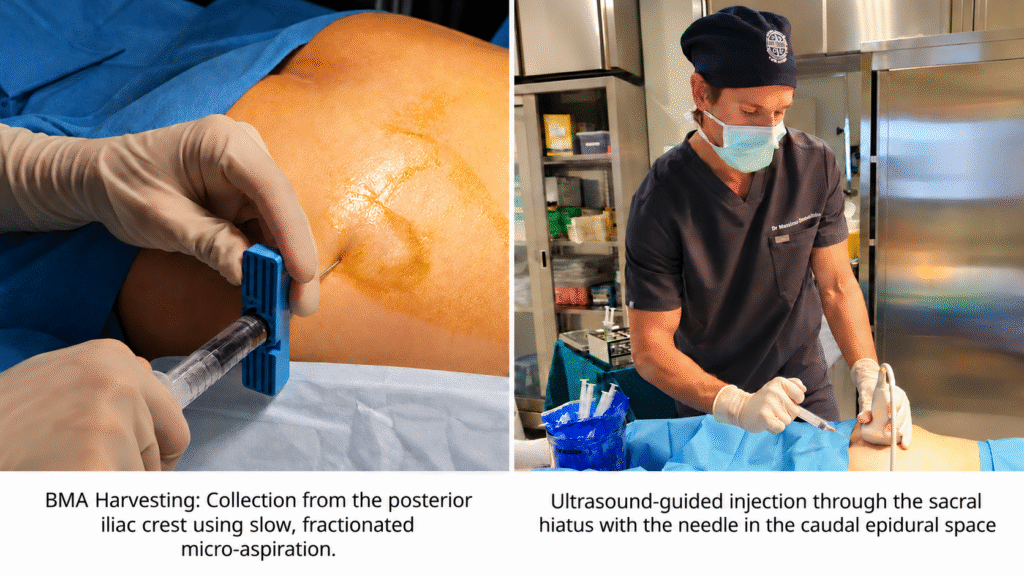
Phase 1 – BMA Harvesting: Harvesting from the posterior iliac crest using slow, fractionated microaspiration.
Phase 2 – Ultrasound-Guided Injection: Ultrasound-guided injection through the sacral hiatus, with the needle positioned in the caudal epidural space.
4. Bioneuromodulation of the Sacral Plexus
Stimulation ascends along the sympathetic chain and vagal pathways toward the nucleus of the solitary tract (NTS).
5. Expected Clinical Benefits
- Improved control of visceral and autonomic functions.
- Support for motor rehabilitation and reduction of neuropathic pain.